May 13, 2026


TL;DR
The Founder Lifecycle is a framework describing four stages of the business owner journey: F1 (starting), F2 (scaling), and F3 (exiting). Each stage brings distinct challenges, questions, and community needs. The right support at the wrong stage is noise. Lower Lincoln is a founder ecosystem in Northwest Indiana built to serve founders at every stage with programming, peer community, and resources matched to where they actually are.
Here is the thing about most business advice: it is written for a founder who does not actually exist. Someone either brand new with no context, or someone who has already figured everything out. The messy, complicated, exhilarating middle, where most actually live, gets largely ignored.
At Lower Lincoln, we believe the kind of support you need changes entirely depending on where you are in the journey. The questions you are asking change, the community that actually helps you changes, and the resources that move the needle change. If you are getting support built for a different stage, it is just noise, well-intentioned maybe, but noise all the same.
Let us talk about the three stages, and more importantly, let us figure out where you fall.
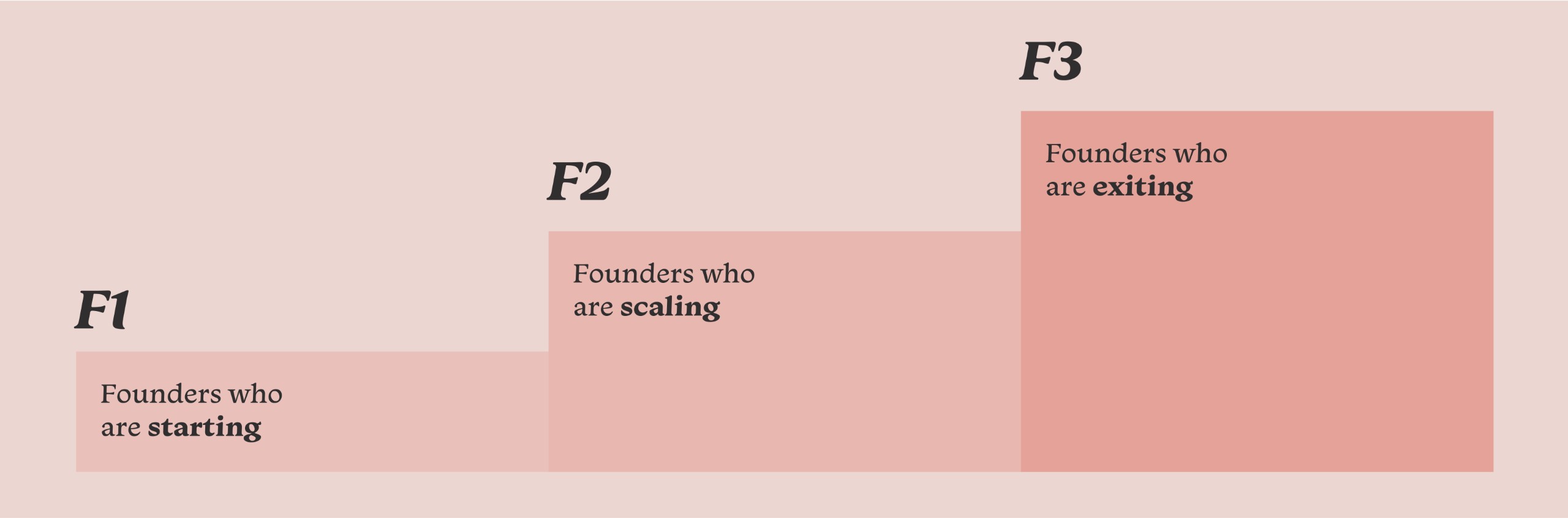
F1’s – Founders Who Are Starting
You have an idea. A gut feeling. A problem that will not leave you alone. And you are starting to wonder if maybe, just maybe, you could actually build something around it.
F1 territory is electric, and honestly, it is also kind of terrifying. There are a thousand voices telling you a thousand different things, and very little of it applies to what you are actually trying to do in the actual place where you are trying to do it.
What you need at this stage is not a pitch deck or a five-year financial model. What you need is someone to take the idea seriously. A room that does not make you feel like an outsider for being early. Validation that the work is worth doing, and people who will help you figure out the real first steps.
The questions F1 founders are asking:
- Is this idea actually viable, or am I fooling myself?
- Who do I talk to when I don’t know what I don’t know?
- How do I stop overthinking and actually start?
- Is there a community here that gets it?
If those questions are sitting somewhere in the back of your head, you are an F1. And you belong here.
F2’s – Founders Who Are Scaling
Something clicked. You have customers, real traction, or at least undeniable proof that what you are building solves a problem people actually have. You are no longer asking whether to do this. You are asking how to do it better, faster, and without everything falling apart in the process.
F2 is where a lot of founders quietly get lonely. The early excitement levels off. The decisions get harder and more expensive. And most of the people around you, genuinely well-meaning as they are, do not quite understand what it costs to keep a growing business alive.
You do not need another feel-good workshop or a motivational speaker. You need people who are in it with you. People who will tell you the truth because they are carrying the same weight. Peers, not cheerleaders.
The questions F2 founders are asking:
- How do I scale without losing what made this work in the first place?
- Who do I talk to when the decisions start costing real money?
- Where do I find people who are honest with me, not just supportive?
- How do I access capital without feeling like I’m starting from scratch?
If you already know you’re at F2, you already know what you need. The question is whether you’ve found it yet.
F3’s – Founders Who Are Exiting
You have been building for years, maybe decades. You have something real: people depending on you, a community that knows your name, a business that genuinely matters. And somewhere along the way, a question starts surfacing that you might not even know how to say out loud yet: what happens to this when I’m done?
Ownership transition is one of the most consequential decisions a business owner will ever make, and it is also one of the loneliest. Most founders arrive here without a plan, without the right advisors, and without a clear picture of what their options even are. By the time they start asking the questions, the clock is already ticking.
This stage does not get talked about enough. Not in business communities, not in founder circles, not in most rooms you have been in. It tends to live in the space between “I’m not ready to think about this yet” and “I waited too long.”
The questions F3 founders are asking:
- What are my actual options when I’m ready to step back?
- How do I protect what I’ve built for the people who depend on it?
- Who do I trust to help me navigate this without just telling me what I want to hear?
- How do I start this conversation before I absolutely have to?
If any of those feel familiar, do not wait. The earlier you start the conversation, the more options you have.
Where Lower Lincoln Comes In
Every stage above has a different community, a different set of questions, and a different kind of support that actually moves the needle. That is not a philosophy at Lower Lincoln. That is the architecture.
Here is how it maps:
For F1 founders:
Founder’s Block is the entry point. It is built for aspiring and early-stage founders who are ready to stop thinking about building and actually start. Community access, founder-focused events, coworking, foundational education, and connections to mentors inside the Lower Lincoln ecosystem.
For F2 founders:
Growth Stage programming is built around real peer community. Roundtables with other operators who are navigating the same season, workshops that are actually tactical, access to investors and funding resources, and accelerator programs that hold you accountable to growth.
For F3 founders:
Ownership Exit Planning (OEP) is a dedicated program for founders who are ready to get serious about what comes next. It covers the full scope, from understanding your options to preparing your business for a successful transition, surrounded by peer community of others in the same high-stakes season and access to legal, financial, and business advisors who specialize in this work.
Every event, every program, and every connection at Lower Lincoln is built with a specific stage in mind. Because you deserve resources that match where you actually are, not where someone else thinks you should be.
The Real Talk
The founder journey is not a straight line. You will move through these stages in your own way and at your own pace. Some days it will feel like you are sitting in two of them at once, and that is okay.
What matters is that you are in the room, doing the work, and building something that matters here.
Northwest Indiana needs more founders who finish what they start. And the best time to find your people is before you need them.
Frequently Asked Questions
How do I know which stage I am in?
If you are still forming your idea and finding your footing, you are likely an F1. If you have traction and need community and resources to scale, you are an F2. If you are thinking about what happens to your business when you step away, you are in F3 and the Ownership Exit Planning conversation is where you belong.
Does Lower Lincoln offer programming for all three stages?
Yes. Events, education, and community are designed with each stage in mind, so what you get from Lower Lincoln reflects where you actually are in the journey, not a one-size-fits-all approach.
What is Ownership Exit Planning and why does it matter?
Ownership Exit Planning is the process of figuring out what happens to your business when you are ready to step back, whether that means selling, succession planning, or something else entirely. Most business owners face this without a plan, and the OEP program at Lower Lincoln is built specifically to change that.
Do I need to be a member to get involved?
Not necessarily. The best first step is to just show up, meet the community, and see what fits. Coworking memberships, day passes, and program enrollment are all available depending on your needs.
Where is Lower Lincoln?
We are at 212 E Lincolnway, Suite LL in downtown Valparaiso, Indiana, right in the heart of Northwest Indiana.